



12 Mar How to Design for Engagement?
Learning happens across time zones and work schedules. Teams log in at different times of the day or night. Some learners participate from remote offices, others between shifts or meetings. And while you added the ‘forum’ activity into the course, no one is posting?
Silence quickly begins to feel like disengagement, and you wonder if anyone is even on your new course or if any actual learning is taking place.
This is usually the point where someone opens the LMS reports, squints at the activity logs, and says something like, “Well… people are logging in.” Which, as any LMS administrator knows, is both technically reassuring and completely unhelpful at the same time.
But silence in online learning doesn’t necessarily mean absence. All too often, a lack of activity can be a simple case of missing structure.
The myth of constant participation
Traditional classrooms or training venues create energy through proximity. People sit in the same room. Ideally, conversations happen naturally around questions that surface organically around the learning topics. Participation becomes visible because everyone shares the same time and place.
Digital learning environments operate differently. Participants can be spread across different locations, accessing the course at different hours, days and sometimes weeks. Learners move through content when their schedules allow it. And in these spaces, reflection often happens quietly rather than publicly. So while an online learning space can look empty, learning is still happening.
Silence in an LMS can therefore be misleading.
A quiet course doesn’t automatically mean disengaged learners. In many cases, it simply means that the course design is expecting the wrong kind of interaction.
Educational researcher Terry Anderson made an important observation in his work on online learning. Engagement in digital environments doesn’t come from constant activity. Instead, meaningful learning happens through three types of interaction:
- Learner ↔ Content
- Learner ↔ Instructor
- Learner ↔ Learner
Here is the visual of the model:
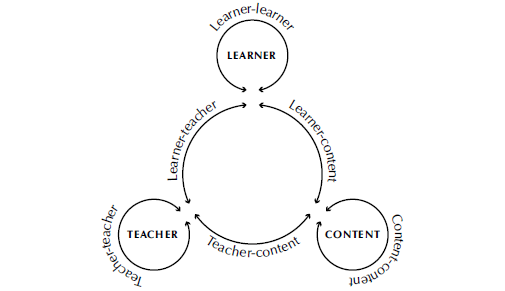
(https://virtualcanuck.ca/category/community-of-inquiry/)
These interactions form the backbone of engagement in online learning environments.
Anderson’s work teaches us that all three types of engagement don’t need to be equally strong. Strong learning can happen when one of these interactions carries more weight than the other types.
A well-designed self-paced course may rely almost entirely on learner ↔ content interaction. Learners read, watch, reflect, attempt quizzes, and move steadily through the material. The forum may stay quiet, but learning is still happening.
This can feel slightly unsettling for course designers who were hoping for lively discussion threads full of thoughtful insights. Instead, learners quietly work through the material, submit their quizzes, and disappear again like highly efficient ghosts.
Other courses rely more heavily on learner ↔ instructor interaction. Coaching programmes, mentoring courses, or specialist professional development often fall into this category. Feedback and guidance become the main drivers of engagement.
Some courses depend strongly on learner ↔ learner interaction. Training seminars, discussion-based programmes, or collaborative projects work best when participants learn from each other.
Trouble usually starts when course designers try to force all three interactions into every course. Forums appear in every module. Group activities are inserted whether they make sense or not. Learners are asked to comment on each other’s posts simply to create visible activity. So while activity increases, meaningful engagement often dwindles.
Most learning designers have seen the classic version of this: the discussion forum where 20 learners politely post their required responses, followed by two equally polite replies that say, “I agree with your point.” Technically, the forum is active. Educationally, it’s the online equivalent of everyone nodding politely and waiting for the very long, unnecessary meeting to end.
Designing engagement is therefore less about generating noise and more about choosing the right interaction to strengthen learning.
Strengthening learner ↔ content interaction
Many professional training programmes benefit most from strong learner–content interaction.
Clear learning pathways make a big difference. Participants should easily see where they are in the course and what comes next. Short activities, quizzes with feedback, and practical exercises help learners interact directly with the material rather than simply reading through slides.
In a well-designed course, the structure quietly guides the learner. People move through the course step by step without needing to stop and figure out what to do next.
Strengthening learner ↔ instructor interaction
Some courses benefit from more visible facilitation.
Instructor feedback, coaching moments, and short interventions help learners navigate difficult concepts. These interactions don’t need to happen constantly since targeted feedback at the right moment often has more impact than constant monitoring.
In many ways, good facilitation in an LMS resembles good refereeing in sport. If everything is working well, you barely notice the referee. When something important happens, however, they appear at exactly the right moment.
Participants feel supported because the instructor steps in when guidance is most needed.
Strengthening learner ↔ learner interaction
Peer interaction can also be powerful when it fits the purpose of the course.
Discussions work well when learners bring their own experience into the learning process. Collaborative problem-solving, case reflections, or shared practice examples often produce rich engagement.
A poorly designed forum, however, quickly becomes the quietest place in the LMS.
What the Karoo can teach us about online learning
Life in the Karoo survives through careful adaptation. Plants grow deep roots to reach water, and energy is conserved. Each organism adapts to the environment rather than trying to overwhelm it.
Online learning environments work in much the same way. Distance, flexible schedules, and distributed participants aren’t problems to eliminate. These conditions simply require thoughtful design.
Strong learning ecosystems emerge when the right interaction is intentionally supported.
Once that interaction is clear, everything else in the course begins to make sense. The forum may become lively or stay quiet. Silence doesn’t always signal a problem.
Sometimes it simply means the course is working exactly as it was designed.
When structure is intentional and clear, participation starts to make sense. Learners move through the course with purpose, instructors know where their presence adds the most value, and the LMS becomes a place where learning quietly but consistently unfolds.
At Limina, this kind of structural thinking sits at the heart of our learning experience design work. A well-designed learning ecosystem rarely looks noisy. It simply works.
By Dr Isabel Tarling