


14 May Structure and Flow in Moodle™: From Maze to Mindful Journey
Structure and Flow in Moodle™:
From Maze to Mindful Journey
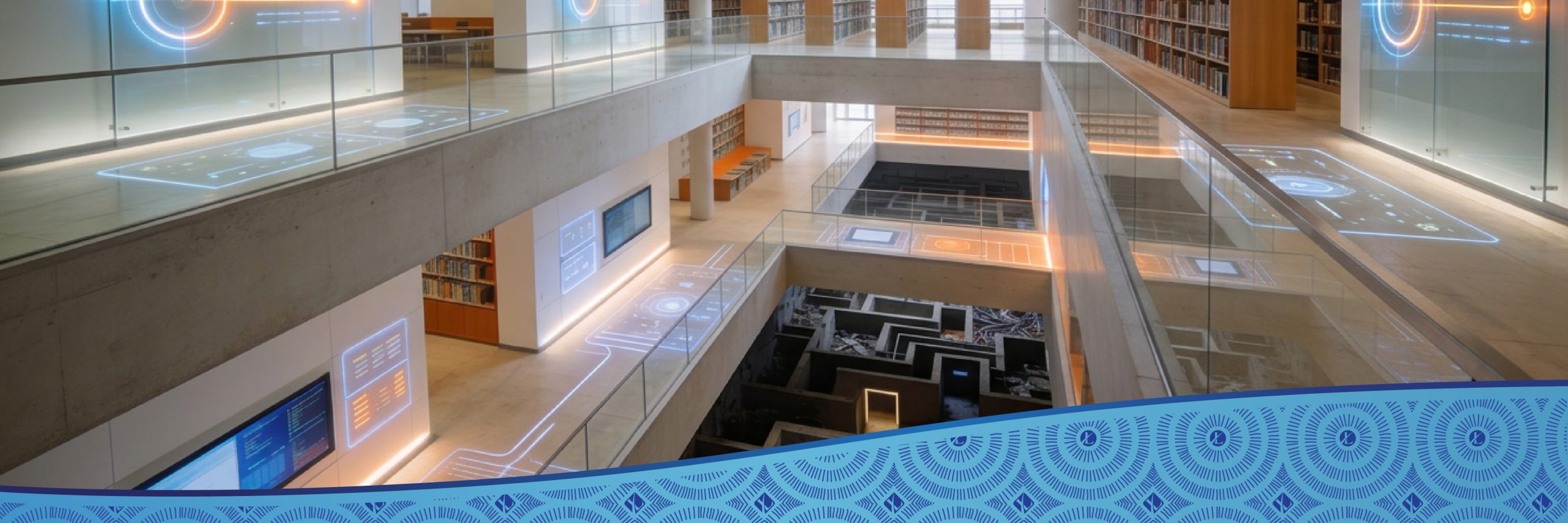
Last Monday, we compared your LMS to a building: just like a well‑designed skyscraper, a good Moodle site should feel like a place where people know where they’re going, with signposts that guide their next steps.
Today, we’re stepping inside the construction site and asking: How do you actually turn a Moodle course into a calm, clear learning journey?
The simplest way to do this is to change how you look at the course on the screen.
Think of Each Course as a Learning “Room”
Instead of thinking of Moodle as a flat grid of links and icons, imagine each course as a room in a building. The furniture is already there in the form of videos, PDFs, quizzes, forums, and assignments. The real question is how you arrange that furniture so people can use it comfortably.
A calm, purposeful room has space to move, a clear focal point, and a sense that you know where you came in and where you’re heading. In Moodle, that means you take time to build clarity to avoid the clutter; you group related activities together so the course doesn’t feel like a maze; and you make sure there is one main path people can follow. When you stop thinking “How much can I fit in?” and start thinking “How do I want this learning journey to feel?”, the design choices become easier.
One Path, Not Ten Detours
The most confusing LMS courses offer learners too many options at once. The course page is packed with three different videos, a few densely packed PDFs, two quizzes and six assignments, and a long forum thread. The learner’s question is not “What do I learn?” but it’s “Where do I click? Where must I go?”
Flow improves when you decide on one primary route through the course. Start with a short, friendly orientation section, then move into a sequence of modules that feel like rooms in a gallery: one after the other, each with a clear theme. Finally, lead them to a simple finish point, such as a summary, a short reflection, or a concise assessment. This doesn’t mean you can’t have optional extras. It just means you stop making them compete with the main path, so they become side rooms you can visit, not detours that feel like the main route.
Consistency as Comfort
In a typical apartment building, you don’t want flat numbers changing floor by floor, where ground level uses plain 101, 102; then the first floor switches to A1, B2; and upstairs, it’s just vague arrows saying “this way, maybe.” Suddenly, finding your friend’s place feels like cracking a code for a treasure hunt, not simply dropping by for coffee.
In Moodle, the same thing happens when every course is laid out differently. One course is modular, one is weekly, one is timeline‑based, and one is just a long list of assignments with hyperlinks to resources. Each time learners enter a new course, they’re re‑learning how to navigate.
Good structure is consistently applied: using the same layout pattern across courses, keeping labels simple and predictable, and avoiding dramatic layout changes unless they serve a clear learning purpose. Predictable structure reduces cognitive load. Instead of the learner wasting that precious cognitive energy on finding their way around, clear structure means they can focus on the learning.
Tools That Shape Flow
Moodle comes with tools that shape the learner’s experience behind the scenes. Progress indicators that show “3 out of 5 activities completed” work like a progress bar along a hallway: learners can see they’re moving forward. Completion tracking can gently guide people from one section to the next, so Module 2 only appears when Module 1 is done. Simple labels and buttons can act like signposts: “Start here,” “Next module,” “You’ve finished.” You don’t need to change every course at once, but you need to use these tools deliberately.
Treating Learners Like Guests, Not Explorers
The most powerful movement in structure and flow comes from how you think about your learners. Are they guests in a thoughtfully designed building, or explorers in an uncharted maze?
If they’re guests, you prepare the space before they arrive, you remove tripping hazards and confusing doors, and you add a few simple cues so they feel oriented the moment they walk in. If they’re explorers, you assume that some will enjoy the puzzle of figuring it out, and you accept that others will get lost, frustrated, or leave early.
Good LMS design means you choose hospitality over mystery. You make the path clear, the signs sensible, and the journey calm enough that people can actually learn, not just survive the navigation.
Make Moodle the Hero of Your Learning Environment
This is where Moodle really shines. It’s not a flashy, locked‑down system — it’s a flexible, open‑source platform that lets you design intentional learning journeys, not just drop content into a box. When you treat Moodle as a design environment, not a file dump, you can shape structure and flow to match your learners’ real‑world needs without paying for a new platform every year.
From Ideas to Impact: Building your Moodle teaching journey with EUM and MEQ
If you’d like to translate these ideas into real‑world Moodle skills, Limina has two pathways to help you move from “making it work” to “making it excellent.” Educators Using Moodle (EUM) is a professional development pathway that helps teachers build confidence, design better‑structured courses, and manage assessment more efficiently, all within familiar Moodle contexts.
For those ready to take the next step, the internationally recognised Moodle Educator Qualification (MEQ) provides formal, independent recognition of your digital teaching competence, assessed against global standards. Together, EUM and MEQ turn the ideas in this post — structure, flow, and learner‑centred design — into a supported, career‑advancing journey for educators who want Moodle to work for them, not against them.
Want to turn these structure‑and‑flow ideas into real‑world Moodle skills?
Explore Educators Using Moodle (EUM) for guided professional development, or find out if you’re ready for the Moodle Educator Qualification (MEQ).
Book a short, no‑obligation conversation with our team to choose the right pathway for you.
You can book a 30-minute conversation with us here: https://calendar.app.google/6S5CUbfSxY5od2pP7
By Chantal Tarling