



Reading Your Moodle’s Vital Signs
In this Article
How to Spot Struggling Courses and Slipping Learners Before It’s Too Late
Last week’s blog ended with a tough question. We now know that success coaching is most effective the earlier we notice and help slipping students. The question is: How do you actually notice individual students when you have 15 courses running and 400 learners logging in at all hours?
Picture the coordinator of a training programme on a Monday morning. Somewhere in those four hundred learners, a handful have gone dark: a nurse who stopped halfway through her compliance course, a new hire who never made it past the first unit, a whole cohort in one region slipping behind everyone else.
The data is all there in Moodle. It is just scattered across logs, reports and activity screens, and by the time anyone pieces it together, the learners have lost interest and dropped out.

The Gap Between Knowing and Seeing
Moodle records almost everything: login, submissions, activity completion – or skipped tasks, non-submissions and no-activity. The trouble is that this record lives in different places, and reading it learner by learner, course by course, can become a full-time job.
The signals that would tell you something is wrong, arrive too late, or never surface at all.
Hospitals have a similar problem, so let’s think about how they handle this. Imagine nurses have to take every patient’s vitals and then record them every few minutes, then rinse and repeat throughout the day. You’d have no nursing – only checking! Instead, a monitor next to each bed shows the vital signs at a glance: heart rate, breathing, temperature. When things go wrong, it raises an alarm to signal the dangerous event. Importantly, the nurse’s attention goes where it is needed, early, before a small problem becomes a crisis.
Your Moodle instance has vital signs too. Logins, activity, completion rates, time since last active, submissions, and assessment results. Read together, they tell you which courses are healthy, which are in trouble, and which learners are starting to slip. The signs are already there. What has been missing is a way to see the ‘learning’ vitals all in one place.
Introducing Limina’s VITALS Dashboard
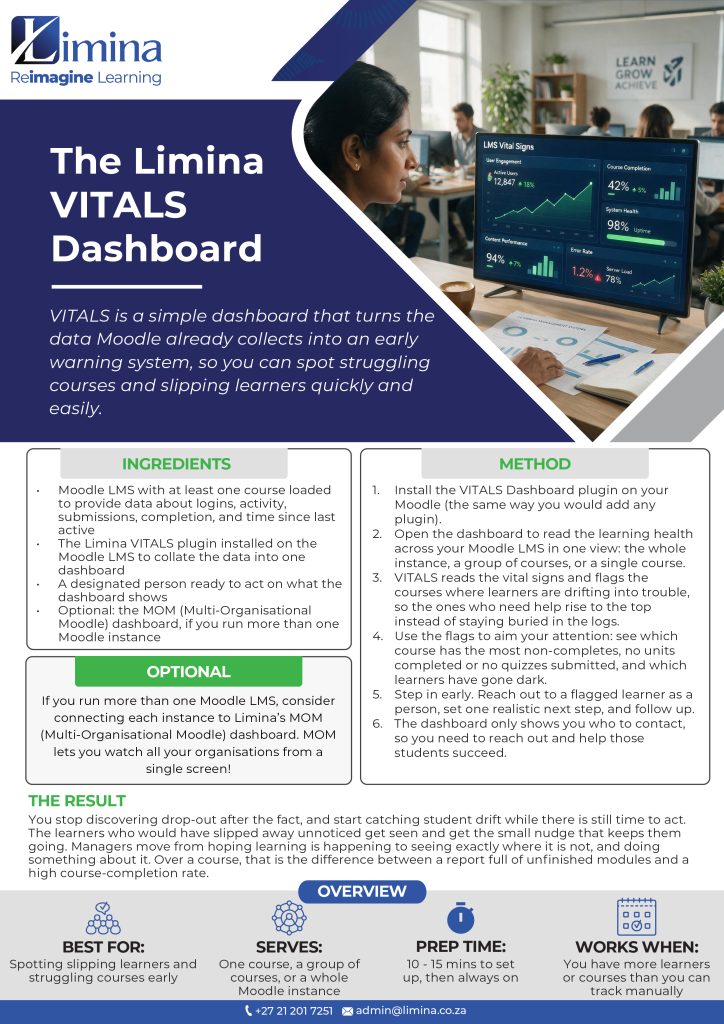
This is why Nico and the team built the Limina VITALS Dashboard. Our Visual Insights and Tracking of At-risk Learning Signals, or VITALS Dashboard, is a Moodle plugin that gathers the data that your LMS already collects and turns it into one clear view.
Instead of digging through separate reports or clicking through different screens, VITALS lets you open a single screen and read the learning vitals or the health of learning in your LMS, all at a glance. You can see the stats for every course, a single course, or a group of courses.
Most importantly, VITALS flags trouble early, so you can see which courses are struggling and send help where it is needed, while there is still time to make a difference.
Recipe for Using VITALS
Recipe for success coaching Using Limina’s VITALS Dashboard
Limina’s Tech and Innovation team built a Moodle plugin that we call VITALS: Visual Insights and Tracking of At-risk Learning Signals. We explain it in the form of a recipe, so you can see how it works in practice.
In conclusion
Here is the part that matters most, and it is where this week meets last week. VITALS will not send a warm message, talk encouragingly and agree on a realistic next step, or believe in someone on a hard day. That is still the cornerman’s job, a real person reaching out.
The VITALS dashboard makes the success manager’s job so much easier, especially when there are hundreds of learners enrolled in many different courses that need support. It does not replace human connection but points us to the struggling learners early enough to help them.
Next week, we close out August with a Client Case Study about the use of the VITALS dashboard. Don’t miss out on a story from the front lines and how VITALS is helping teachers in our Maths Problem Solving courses!
Ready to See the Health of Your LMS at a Glance?
If you’re managing hundreds of learners across multiple courses, you shouldn’t have to dig through reports to find the ones who need help. Book a complimentary 30-minute conversation with Limina and let’s explore how better Moodle insights could help you spot learner and course risk earlier—and act while there’s still time.
Free Download: One-Page Success Coaching Checklist
Keep this practical coaching guide close at hand.
Subscribe to the Limina newsletter and receive our complimentary one-page Success Coaching Checklist—a quick-reference PDF with four proven coaching actions to help more learners stay on track and finish strong.

Dr Isabel Tarling – CEO
Isabel Tarling is a learning sciences scholar, programme designer and education researcher, with a PhD from the University of Cape Town. Her research in online and technology-supported learning forms the foundation for much of her writing. She aims to build easy-to-understand bridges between evidence-based research and its everyday application in real-world contexts. Isabel is the founder of Limina, where these ideas are put to work to reimagine learning for organisations of all shapes and sizes.