



How Much of Your Course Should AI Actually Build?
In this Article
ProTip! Answer This Before You Open an AI Course Builder
A second-hand car can look immaculate after someone has painted over the rust. The shine is real. So is the rust underneath.
AI course builders can do something similar to learning design. Give them a manual, a slide deck, or a collection of PDFs, and they can produce something polished, interactive and unmistakably course-shaped in remarkably little time. We use AI for exactly this kind of work ourselves.
The problem appears when polish hides weak learning design underneath.
Writing a knowledge check about a settled fact is one kind of design task. Deciding how long a learner should wrestle with an uncomfortable idea before you step in is another. AI can help with both, although the amount of responsibility we give it should be very different.
That is why the useful question is no longer simply: Can AI build my course?
A better question is: How much of this particular learning task should I give to the AI intern?
Every Course Has Different Kinds of Learning
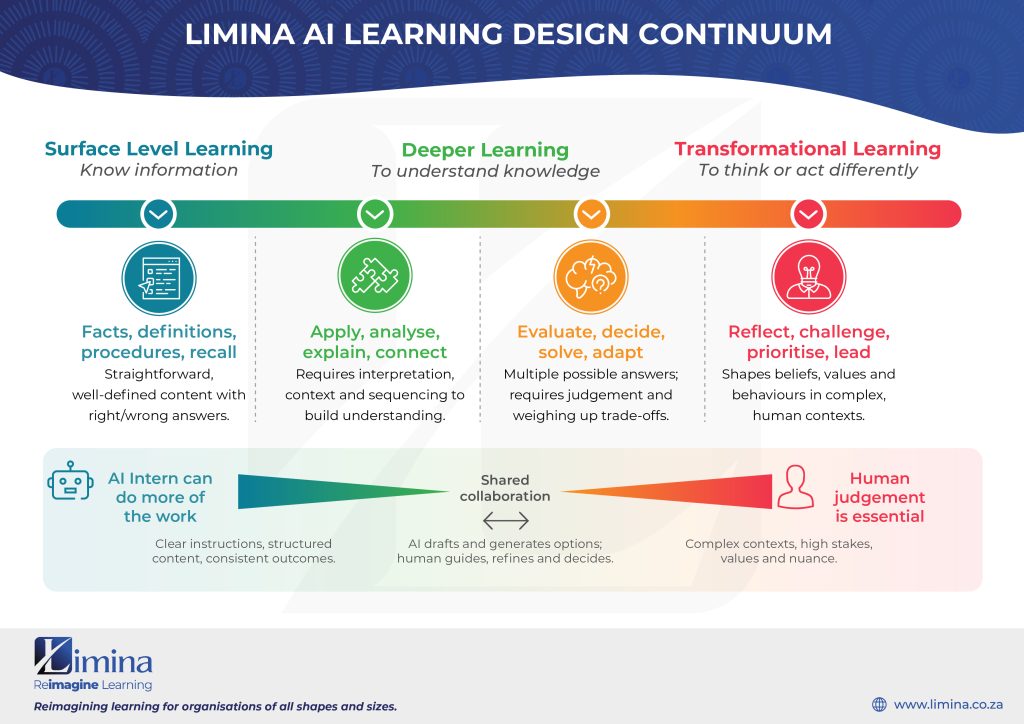
Our LXD team found it useful to think about the learning within a course as sitting on a continuum. At one end is more surface-level learning: facts, information and clearly defined procedures. As the learning deepens, students need to make connections, interpret ideas and apply what they know. Further along are learning experiences intended to help someone think, judge or act differently.
Learning, of course, does not fit neatly into these categories, but it generally helps us see how the learning in a course usually contains work from across the continuum.
David Jonassen’s work on well- and ill-structured problems helps us think more clearly about this. In a course, some tasks have a limited set of rules and clear criteria for judging an answer. Think about tasks like calculating VAT, following a safety procedure or knowing which form to file. Other tasks have several possible answers, competing considerations and no obvious rule telling you what to do. Think, for example, of leading a team through a difficult year, weighing two principles that pull in opposite directions, or reflecting honestly on your own practice. We use that distinction as a lens for judging how much pedagogical judgement a task demands. That, in turn, helps us decide how far we are prepared to lean on our AI intern.
We capture this thinking on Limina’s AI Learning Design Continuum illustrated in the attached image. This continuum shows how increasing learning complexity usually brings an increasing need for human judgement in the design and shapes how the AI intern is used.
Where the AI Intern Excels
The AI intern works extremely well at the surface-level end of the continuum. The source material is generally clear, the constraints are known, and there is a reasonably obvious way to check the output.
Give it a manual and a clear brief, and it can:
- turn the material into draft modules
- break long content into sensible chunks
- rearrange and tidy repetitive content
- create draft knowledge checks
- suggest examples or explanatory visuals
- write alt text for images
This work used to consume days of a learning designer’s time. The AI intern can now carry much of the production while the human checks accuracy, corrects and polishes.
When the AI Intern Starts to Struggle
The relationship changes as the learning moves further along the continuum.
Questions become harder to specify:
- What does the learner need to understand first?
- Which misconception should we tackle?
- Which example will make sense to this particular group?
- How should the learning be sequenced so understanding builds?
This middle section on the continuum is where the AI intern drafts and the learning designer directs. AI can produce options at speed, but someone with knowledge of human learning still needs to decide how those pieces form a coherent learning experience.
The difficulty is that weaknesses in the design can be surprisingly hard to see. An activity that the AI intern created may read well and look polished, but the human learning designers will quickly spot where the sequencing is slightly off, the example assumes knowledge the learner does not yet have, or the activity asks too much too soon.
Regenerating the content may simply produce another polished version of the same underlying design problem. That is when the task needs to stay closer to the human learning designer and the AI intern can provide support.

Where Human Judgement Matters Most
Further along the continuum are learning tasks intended to change how someone thinks, exercises judgement or acts.
Learners may need to question assumptions, weigh competing ideas, reflect honestly on their own practice or make decisions where there is no single correct answer. Human judgement becomes central to the design here.
Jack Mezirow’s work on transformative learning helps explain why. Transformative learning can involve experiences that challenge the assumptions through which someone has been making sense of the world, sometimes leading them to examine and change that frame.
Designing this kind of learning means thinking carefully about context, challenge, support and timing. A designer needs to know when the learner needs an explanation, when they need space to think, or when staying with an uncomfortable idea is part of the learning process.
The AI intern still has a role. It can generate scenarios, suggest questions, draft wording and offer alternatives. However, the consequential learning decisions need to stay with the human learning designer.
Where Your AI Intern Becomes a Strong Partner
AI has already changed the way we build courses around the world, and not always for the better. At Limina, we use our AI interns every day, and we certainly don’t want to return to a completely manual course-development process.
The skill lies in deciding where and how to use the AI intern in the best possible way. Surface-level work can often be handed over and checked. Deeper learning needs closer direction from the learning designer. Learning intended to develop judgement, challenge assumptions, or change behaviour needs human judgement sitting firmly at the centre.
That is what we mean when we say:

The AI intern should save your learning designers from spending hours on work a machine can do well. That gives them more time for the work that requires their expertise: understanding the learner, shaping the experience, and making the decisions that determine whether the learning actually lands.
Keep our one-page decision guide beside you as you work on your next build – it’s free with our newsletter.
Planning a new course and need our help?
Book your spot to have that conversation with our team.
We have also turned this into a one-page decision guide you can keep beside you on your next build. It is free when you subscribe to our newsletter.
Free Download
Sign up for our newsletter to receive this month’s decision guide for learning teams. It gives you the decision tree for knowing which parts of learning design AI can help with and the parts you still need a human designer for.
References
Jonassen, D. H. (1997). Instructional design models for well-structured and ill-structured problem-solving learning outcomes. Educational Technology Research and Development, 45(1), 65–94.
Mezirow, J. (1991). Transformative dimensions of adult learning. Jossey-Bass.

Dr Isabel Tarling – CEO
Isabel Tarling is a learning sciences scholar, programme designer and education researcher, with a PhD from the University of Cape Town. Her research in online and technology-supported learning forms the foundation for much of her writing. She aims to build easy-to-understand bridges between evidence-based research and its everyday application in real-world contexts. Isabel is the founder of Limina, where these ideas are put to work to reimagine learning for organisations of all shapes and sizes.