Designing Assessment for Practice-Based Learning

In this Article

Assessments That Use Moodle and AI

Assessing students completing workplace learning is no easy task. We want Portfolios of Evidence, but don’t want mountains of files and paper submissions. Digital submissions aren’t all they’re made up to be either. Like the paper version, it often seems they’re completed the night before submission!

A useful Portfolio of Evidence should capture learning as it happens, make it visible and collect the evidence in a way that is easy to follow and assess. A tall order if your learning management tools are clunky and stuck in one unit or module.

Last week, we explored four questions for assessment in an AI-rich world: what students can do independently, what they can do with support, how well they judge that support, and whether their learning carries into another context or point in time.

This week we walk with Dr Z as she uses Moodle to capture workplace learning as it unfolds.

Assessing a Student Teacher’s Workplace Learning

Dr Z teaches Becky, a Life Sciences student teacher completing teaching practice at a Northern Cape school. Becky teaches large Grade 8 and 9 classes with limited resources and very different levels of prior knowledge.

English is the language of instruction, but learners frequently code-switch to Sesotho or Setswana. Other teachers can switch languages to explain a difficult concept, but Becky can’t, which adds another layer of complexity.

Dr Z wants to assess how Becky is learning to teach in this context. She develops her students’ assessments, and she uses a simple framework:

Decide what the assessment needs to show.

Build the evidence trail.

Use the evidence to guide learning and judgement.

1. Define What the Assessment Needs to Show

Student teachers typically prepare a lesson plan for the lesson their lecturer observes. This is assessed with a rubric, very often a paper-based one!

Dr Z doesn’t want one crit lesson to carry the full weight of Becky’s assessment. Many things can go wrong on the day, and one snapshot is an unreliable measure of a developing teacher. 

Instead, she wants to build tasks that give her insight into Becky’s growing knowledge and skill about teaching while she is at the teaching prac school. She wants evidence of how Becky plans, explains difficult concepts, responds when learners struggle, checks whether learning is happening and uses feedback to improve.

2. Build the Evidence Trail

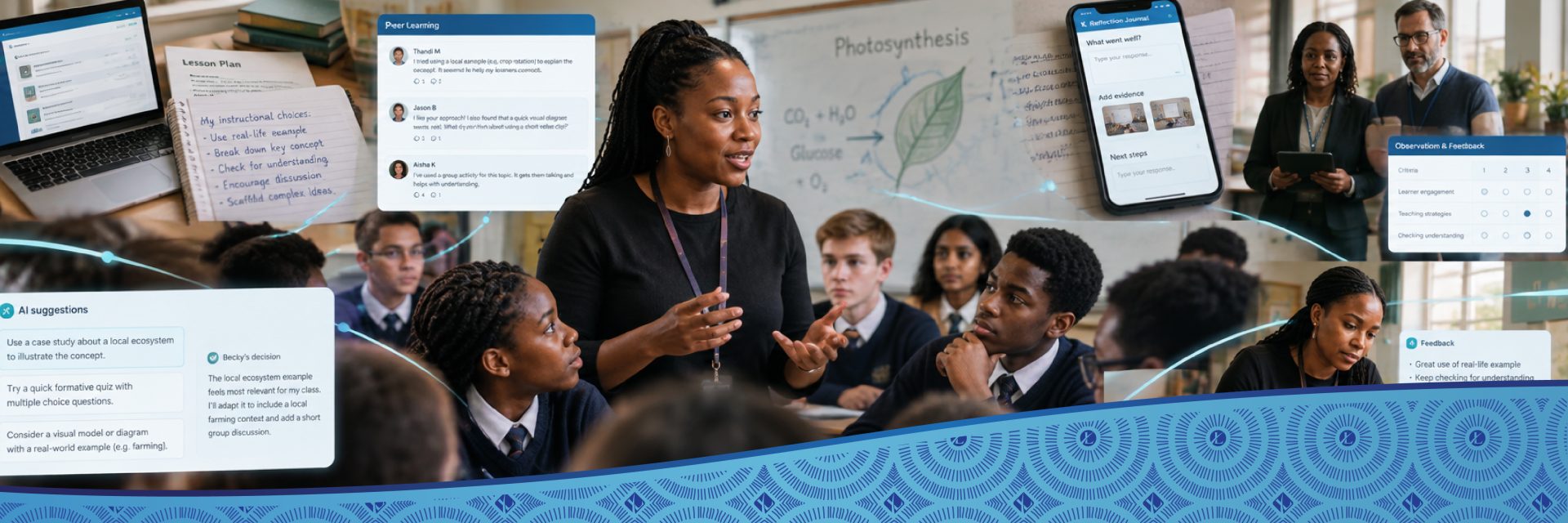
Before teaching practice, Dr Z creates a PinBoard task in Moodle where students discuss a difficult lesson and how they might teach it. Knowing code-switching is common, she asks how they would respond if learners switch into a language they don’t understand. During teaching practice, they show which ideas influenced their lesson planning and why.

Dr Z also creates a structured Reflection Journal in Moodle. Becky uses her phone each week to reflect on where learners struggled, what surprised her, what she changed and what she wants to try next. She can attach lesson plans, photographs, voice notes or short videos. The journal closes each Sunday at midnight, so her reflections are in before the next teaching week begins.

Before her crit lesson, Becky uploads her lesson plan, teaching resources and a short rationale explaining her choices, anticipated misconceptions and how she will check learners’ understanding.

Then she teaches.

Several learners struggle with a key concept. Becky changes her explanation, uses a simpler example, and checks whether they’re following. Some are still unsure, so she tries another approach.

Dr Z observes the lesson with Moodle open on her phone. She has recreated the old paper-based assessment rubric in Moodle, so she scores Becky and records comments as the lesson unfolds. Becky’s mentor teacher is also signed into the university Moodle and completes the same rubric.

Afterwards, the three compare what Becky planned with what happened in the lesson. The mentor teacher praises the way she adjusted her explanations, while Dr Z reassures her that unexpected learner reactions are part of learning to teach.

3. Use the Evidence to Guide Learning and Judgement

Back in her Reflection Journal, Becky works through the feedback and identifies what she wants to change in her next lesson.

At the university, Dr Z reviews Becky’s PinBoard contribution, weekly reflections, lesson plans, teaching rationale, observed lessons and the two rubrics that she and the mentor teacher submitted. Together, they show how Becky’s thinking and practice are developing.

The two rubrics are useful because Dr Z and the mentor teacher noticed different aspects of Becky’s teaching. Another reflection or observation can fill any remaining gaps, and Dr Z can leave notes for the lecturer doing Becky’s next observation.

Best of all, she doesn’t have to go click-clicking through piles of paper and disconnected submissions. Moodle gives her one place to review the evidence, mark and leave feedback.

AI Can Be Part of the Evidence Trail Too

Becky uses AI for lesson ideas, alternative explanations and to identify likely misconceptions. She asks it to help her spot blind spots in feedback from earlier lessons. She quickly realises that most suggestions would only work in a small, well-resourced classroom with three learners. They’re hopelessly off the mark for Becky’s large Grade 8 and 9 classes.

Becky recognises this, adapts useful ideas and rejects what won’t work, noting her choices in her weekly reflections. That gives Dr Z evidence of her growing judgement as a teacher.

This is the evaluative judgement we discussed last week: the ability to recognise quality, weigh up options and make sound decisions about what to use.

The trick is including a prompt in the Reflection Journal asking students to reflect on how they used AI. In this way, AI participates in Becky’s learning without making her learning invisible.

Designing Assessment for an AI-Rich World

Practice teaching gives us a useful model for combining academic learning with evidence from practical application.

Moodle helps Dr Z capture evidence through discussion, planning, reflection, observation and feedback. AI can now participate in almost every assessment activity we use, which highlights the importance of thoughtful assessment design.

The same thinking applies far beyond teaching practice. A Moodle quiz, PinBoard discussion, Reflection Journal entry, assignment, presentation or practical task can each contribute evidence. Across activities, contexts and time, they build a programme-level picture of what students can do independently, how they use and judge support, and whether they can apply their learning again.

That gives us a stronger basis for answering the question that started this series:

What can we reasonably say about the learning that has taken place?

The biggest take-away from this blog is to design enough opportunities for the learning to become visible, then gather enough evidence to make a valid claim about it.

Sign up for our newsletter

Would you like the 7 Principles for Assessment Design beside you while you plan? Sign up for the Limina newsletter, and we’ll send you our weekly blog, plus a print-ready copy to save, print or share with your team.

Your subscription could not be saved. Please try again.
Your subscription has been successful.

Newsletter

Subscribe to our newsletter and stay updated.

Dr. Isabel Tarling – CEO at Limina
Dr Isabel Tarling – CEO

Isabel Tarling is a learning sciences scholar, programme designer and education researcher, with a PhD from the University of Cape Town. Her research in online and technology-supported learning forms the foundation for much of her writing. She aims to build easy-to-understand bridges between evidence-based research and its everyday application in real-world contexts. Isabel is the founder of Limina, where these ideas are put to work to reimagine learning for organisations of all shapes and sizes.

Research has a habit of getting stuck between the pages of journals and books, or somewhere between academic language and everyday practice. Our blogs help get those ideas moving. We dig into the research, unpack complicated ideas and work out what they mean for people who design, support and care about learning. Then we draw out useful principles, processes and strategies that can travel into practice, across all the wonderfully varied places and ways in which learning happens.