


Coaching Maths Teachers to the Finish Line
In this Article
Limina’s Client: The South African Mathematics Foundation
The South African Mathematics Foundation (SAMF) develops mathematical thinking in the country’s schools, classrooms, learners and teachers. SAMF helps teachers move beyond drilling formulas to thinking like mathematicians, then pass that thinking on to their learners. It does this through the national Maths Olympiad, the Siyanqoba training programme, and its online teacher courses, reaching classrooms across all nine provinces.
The Challenge
In 2021, SAMF came to Limina wanting online courses that build teachers’ capacity to solve non-routine problems. Their aim was to reach teachers who had not benefited from such training in the past, who tend to work in schools with poor connectivity and limited resources.
Online learning could reach them, but it carries a well-known risk. Teachers enrol, determined and excited about the course, but weeks later, many have never logged in, let alone started the course, and of those who logged in, a large group drifted away before the learning even took place. The cost of this is too high: every teacher who never finishes represents multiple classrooms of learners who miss out. SAMF needed teachers to arrive, to start, and to finish, so we rethought the support we offered teachers.
The Work: An Evolution of Limina’s Success Coaching
Getting teachers to complete their MPS courses became a craft we refined over five years.
Between 2022 and 2023, our team watched the courses daily, emailed or phoned teachers who went missing, and opened second-chance windows for those who fell behind. It worked through sheer effort: hours scrolling through Moodle data, then messages and calls, one teacher at a time. It was heroic, but it did not scale.
In 2024 and 2025, that manual checking was formalised into a named success coaching framework, with pillars for coaching, technical help and administration. We added a chatbot for the simplest questions, and visualised reports for a quick overview of each course. Now the team could target specific teachers first, then give their time to the ones who needed a person-to-person conversation.
The Turn
One lesson stood out, though: you cannot coach a teacher across a gap you cannot see.
Each year, we learnt to read the learning journey more precisely. Early on, we only knew whether a teacher had started or not. Then we learnt to separate the teachers who had logged in and stalled from those who had never logged in at all, and found that most of our “no-shows” had never made it through the front door. That reshaped our approach: we moved onboarding earlier, cleared login problems before the course clock started, and sent navigation videos ahead of day one.
Reading that journey meant piecing together data from scattered Moodle screens. Through 2024 and 2025, we built our own views, but they were clunky and slow, and showed one course at a time.
The VITALS Dashboard
In 2026, our Tech and Innovation team set out to solve this and built our VITALS Dashboard: Visual Insights and Tracking of At-risk Learning Signals.
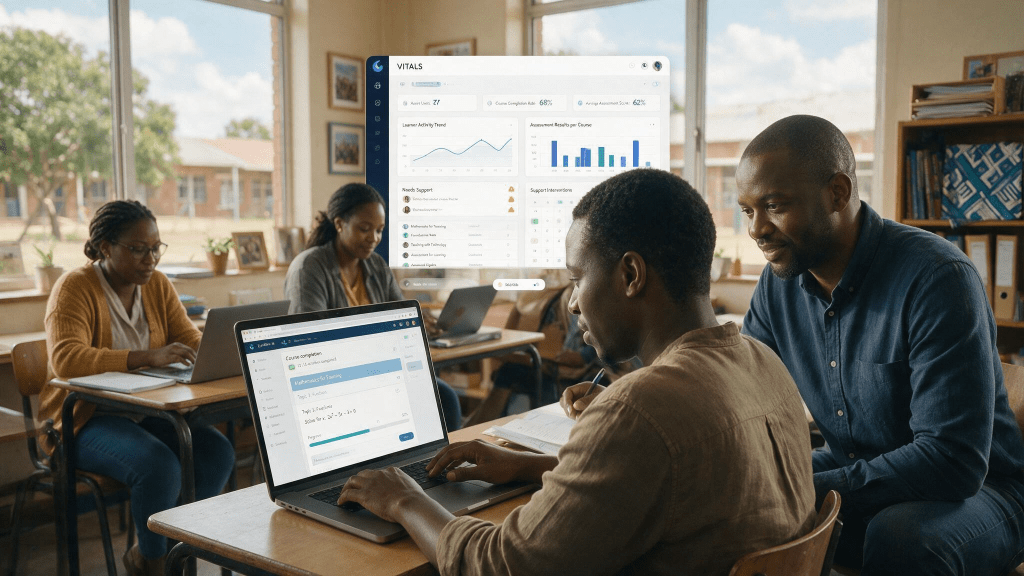
VITALS gathers the data from across a Moodle LMS into one clear, filterable view. On a single screen, a course manager sees what is happening in every course at once:

How many teachers are enrolled, engaged, or not yet started.

The activity completion for each unit.

The assessment results across units and courses.

The completion rate of every course.
The scattered numbers that once took hours to piece together now sit in one place. Instead of guessing where help is needed, the VITALS dashboard shows the team exactly who to reach out to:
- Who to call: the teachers who have not logged in for a week, or whose activity has stalled.
- Who to sit down with: the teachers whose assessment results are slipping unit after unit.
VITALS also lets SAMF log into their own MPS courses in real time and compare them to previous years. They can gauge the learning health of any course instantly, and track from week to week how well our success coaching is working, by reading the results after each Monday and Tuesday call drive.
The Results
In recent years, between 84% and 100% of the teachers who start Unit 1 have gone on to complete the course. This is our measure of success coaching: its job is to hold a teacher who has started to the end, and on that measure it works.
Success coaching built on VITALS data still comes down to person-to-person contact. Shannon, one of our success managers, supports the High School MPS course. She describes how it works:

"I start by looking through the stats to see where engagement is low, then I call or WhatsApp those teachers to find out how I can help. In the first week, we had 17 teachers finish Unit 1. After I called them, the next day, I think 35 were working on the course. It helped that there wasn't a robot on the other end of the line, but an actual person giving them encouragement."
VITALS shows our team where to look. Then Shannon, Oyama or Sherisse do the rest, and put a real person, not a robot, in the teacher’s corner.
We cannot change unreliable devices, expensive data, or a packed school calendar. What we can do is place ourselves squarely in teachers’ corners. Like in a boxing match, we are here to get them to the finish.
Work With Us
If your organisation is working to reach learners at scale and carry them all the way to the finish, we would love to help you do it. It starts with seeing who needs support, and then being the person who shows up.
Free Download: One-Page Success Coaching Checklist
Keep this practical coaching guide close at hand.
Subscribe to the Limina newsletter and receive our complimentary one-page Success Coaching Checklist—a quick-reference PDF with four proven coaching actions to help more learners stay on track and finish strong.

Dr Isabel Tarling – CEO
Isabel Tarling is a learning sciences scholar, programme designer and education researcher, with a PhD from the University of Cape Town. Her research in online and technology-supported learning forms the foundation for much of her writing. She aims to build easy-to-understand bridges between evidence-based research and its everyday application in real-world contexts. Isabel is the founder of Limina, where these ideas are put to work to reimagine learning for organisations of all shapes and sizes.