



Reflection Matters a Great Deal, so How Can We Improve This in Course Development?
In this Article
At the end of a three-week course, jam-packed with case studies, difficult conversations, feedback, and practice, a lonely box beckons, asking the student:
What did you learn?
The student responds: “I learnt that communication is important,” clicks Submit, and closes the tab. Reflection done and dusted, certificate received and printed, and life goes on.
When this is the only point in the course where students are encouraged to reflect, a great deal of potential learning can slip past. Throughout the course, decisions were made, assumptions tested, and feedback was given. Some ideas fitted comfortably with what students already believed, while others rubbed against long-held beliefs or ways of doing things. Without purposefully sitting and reflecting on this, the danger is that the learning slips by and remains (almost) unnoticed.
Reflection gives learners time to return to those moments, turn them over, make connections and work out what the learning means for them.
The depth of that reflection depends heavily on what we ask students to do in the learning journey.
Reflection Helps Students Make Meaning
Reflection gives students space to think, for instance, about a problem they solved, a conversation they handled, feedback they received, a decision they made, or an idea that challenged them. Ash and Clayton (2009) describe critical reflection as a process that can help learners generate, deepen and document learning from experience.
When a student reflects on experiences, it means they take a moment to pause and connect new learning with existing knowledge, beliefs and perceptions. Take, for example, a workplace experience or feedback from a supervisor. Through reflection, they connect their experience with ideas introduced earlier in the course, or they reconsider their performance in light of the feedback they received.
Reflection can, however, also operate as a metacognitive tool to help the student think about their own learning, their own thinking, understanding, decisions and learning strategies. Hattie’s research draws together a large body of evidence on the factors that influence learning. Metacognitive strategies, including evaluation and reflection, and feedback from teachers, all sit among the higher-impact influences.
This gives learning designers useful tools to work with: reflection can help students examine their thinking, while timely feedback gives them information they can use to refine it.
The Depth of the Reflection Should Match the Learning
Reflection can support different forms of learning across Limina’s Learning Design Continuum.
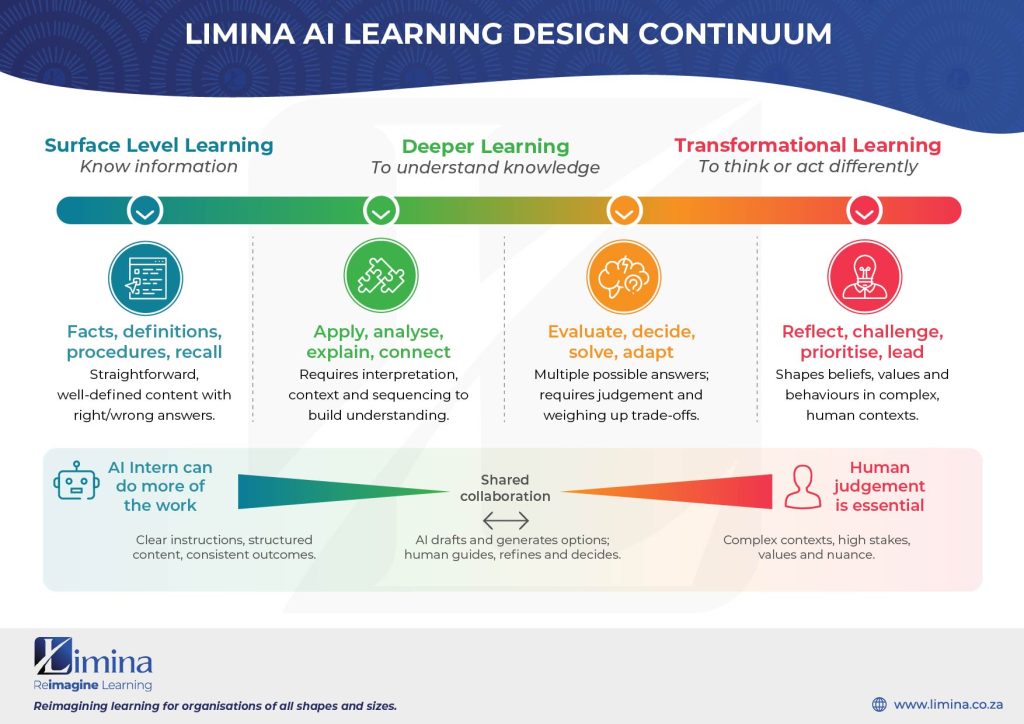
- At a surface-learning level, reflection can help students recall key ideas, recognise mistakes, identify gaps in understanding and decide what they still need to practise.
- At a deeper-learning level, reflection can help students connect ideas, explain their reasoning, analyse decisions, apply concepts and consider different interpretations.
- At a transformational-learning level, reflection can help students examine assumptions, beliefs and frames of reference that shape how they interpret experience. Mezirow (1997) describes transformative learning as a process through which adults may come to examine and revise these frames of reference.
The reflective questions we design should therefore match what we want students to do with the learning.
Consider three examples:

What were the three most important things you learned in this module?
In a compliance course, this can help a student recall and consolidate important information.

Why did you choose that approach, and what information helped you make the decision?
In an ethics or professional judgement course, this guides the student to examine their reasoning and apply what they learned.

What assumptions shaped the way you interpreted this situation?
In a leadership programme, this can help students surface and examine beliefs or habitual ways of thinking that influenced their judgement.
Each question asks the learner to do different cognitive work. The learning purpose guides the depth of reflection required.
Reflection Grounded in Practice
Some learning contexts give students artefacts from their own practice. A photograph, video, workplace document, observation, supervisor feedback, project output or signed logbook can anchor reflection in a particular moment.
This becomes particularly useful in work-integrated learning and portfolios of evidence.
With the artefact in front of them, students can ask:
- What does this show about my practice?
- What was I thinking at the time?
- What information influenced my decision?
- What feedback did I receive?
- What has changed since then?
- What evidence is there that I have changed how I think or act?
Across time, these reflections can help students recognise patterns in their own development.
Good Reflection Needs Deliberate Design
Sophisticated reflection is a skill that develops with guidance and practice.
Students need support to develop their capacity to reflect at deeper or more sophisticated levels. Learning designers can scaffold this progressively across a course, using prompts and feedback to guide increasingly complex thinking (Ryan & Ryan, 2013; Wald et al., 2012).
Questions might move through a sequence such as:
- What happened or stood out?
- What informed your response?
- What evidence supports your interpretation?
- What other explanations are possible?
- What assumptions were you bringing into the situation?
- What might you do differently?
Every student does not need every question. The learner, context and learning purpose determine what is appropriate.
The conditions matter too. Students need clarity about why they are reflecting, who will see their responses, whether they can expect feedback, how the reflections will be used and whether they will be assessed. Clear expectations help create the trust required for students to meaningfully engage in the reflective process.
Design Reflection With Purpose
Reflection can help students consolidate an idea, connect theory with practice, examine a decision, recognise a pattern or reconsider a deeply held assumption.
Purposeful design is what gives reflection its value in the learning journey.
A useful question for any course is:
What are we asking students to do with their learning, and have we designed the reflection to help them do it?
Looking for a meaningful way to build reflection into your courses?
 Download our practical guide to different reflection frameworks and discover how you can use them in your course design.
Sign up for our weekly newsletter to get the guide, plus more useful learning tools and resources delivered to your inbox, so you’ll never miss out!
At Limina, questions like this often shape the tools we build. We saw the need for a structured reflection tool that would collect evidence and document a student’s development over time, and which would sit within Moodle. So we built one!
Next week, we’ll introduce the Limina Reflection Journal and show what that looks like in practice.
Free Download
Sign up for our newsletter to receive this month’s Reflection Structures for Learning Designers.
References
Ash, S. L., & Clayton, P. H. (2009). Generating, deepening, and documenting learning: The power of critical reflection in applied learning. Journal of Applied Learning in Higher Education, 1(1), 25–48.
Hattie, J.A.C., & Donoghue, G. M. (2016). Learning strategies: A synthesis and conceptual model. npj Science of Learning, 1, 16013. https://doi.org/10.1038/npjscilearn.2016.13
Mezirow, J. (1997). Transformative learning: Theory to practice. New Directions for Adult and Continuing Education, 1997(74), 5–12. https://doi.org/10.1002/ace.7401
Ryan, M., & Ryan, M. (2013). Theorising a model for teaching and assessing reflective learning in higher education. Higher Education Research & Development, 32(2), 244–257. https://doi.org/10.1080/07294360.2012.661704
Wald, H. S., Borkan, J. M., Taylor, J. S., Anthony, D., & Reis, S. P. (2012). Fostering and evaluating reflective capacity in medical education: Developing the REFLECT rubric for assessing reflective writing. Academic Medicine, 87(1), 41–50. https://doi.org/10.1097/ACM.0b013e31823b55fa

Dr Isabel Tarling – CEO
Isabel Tarling is a learning sciences scholar, programme designer and education researcher, with a PhD from the University of Cape Town. Her research in online and technology-supported learning forms the foundation for much of her writing. She aims to build easy-to-understand bridges between evidence-based research and its everyday application in real-world contexts. Isabel is the founder of Limina, where these ideas are put to work to reimagine learning for organisations of all shapes and sizes.