Start With ‘Why’ Before you let AI Build your Courses
In this Article
Three months in, the course had still not been built. Alex and Gerald came to us in March 2026 with a curriculum they had spent years creating. Forty+ units drawing on philosophy, complex systems theory, reflection, contemplation, and the daily practices that shape the mind. They had run it all in-person for years, and now wanted to take it online so it could reach people anywhere in the world.
Initially, we experimented with AI. We fed their PDFs and slides into an AI course builder. The outputs looked useful at first, but the essence of their course content had shifted. Then we refined the prompts and tested, refined them even more and tested over and over. The AI did what AI does, and did it relatively fast. The activities were flashy and interactive, but the results were still only about 60% right. The philosophy was changed, core messages lost, and the content didn’t even sound like them anymore.
After three months of AI prompting and retrying, we stopped the bus. At this point, we faced the same question organisations building online learning face daily, and one that needs an answer before building anything or opening any AI course builder. It’s Simon Sinek’s question, applied to learning:

Why are you building the course? What is it actually meant to do for the person who finishes it?
Two Very Different Learning ‘Whys’
At Limina, our clients have vastly different learning needs, which shape how we approach the learning design process.
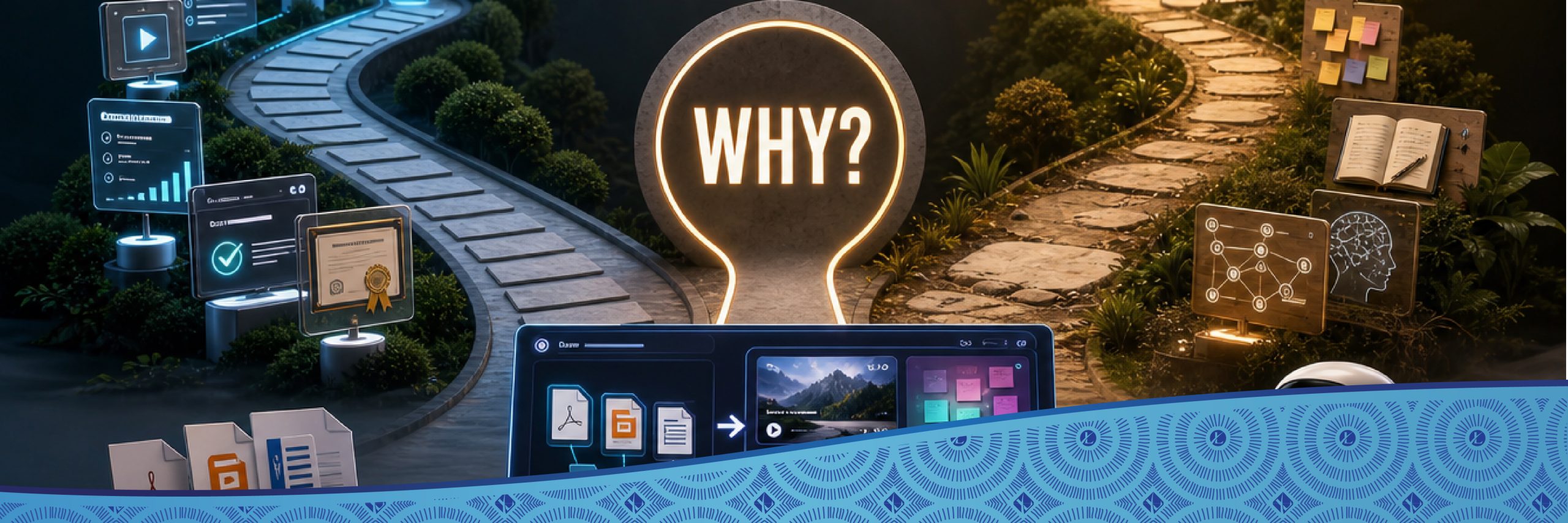
Take Antoine, for example, who runs an academy for transport and driver training. Students from his academy need to leave each course knowing a defined set of rules and be able to make sound decisions in a split second on the road. Their course content consists of a defined body of knowledge and a clear set of competencies, and at the end, the student either has it or they don’t. A well-built course for Antoine organises the content clearly, holds the learner’s attention, checks their understanding at key points, and issues a certificate at the end. The ‘why’ of this course is to transfer content and develop skills.
Alex and Gerald’s courses do a completely different kind of work. Their ‘why’ is to shift students’ thinking about the world, and not to transfer knowledge. In their courses, you cannot test if a student learnt the formula for contemplation like Antoine would test if someone can park a bus. Alex and Gerald’s students have to sit with a question themselves, develop the patience to stay with it, and discover what happens as their thinking slowly starts to open up. A well-built course for Alex and Gerald needs to present well-organised content, but has very few quizzes or tests. Instead, there are spaces for individual (private) reflection, social engagement on the group PinBoards, and a journal to capture each student’s learning journey. The ‘why’ of this course is to shift how someone thinks.
Both courses do very different jobs, with very different ‘whys’.
Pros and Cons of the AI Learning Design Intern
AI course-building tools are springing up across the internet, promising spectacular results from the tired PDFs and slides you already have. Upload your content, and the AI will transform it into a legitimate course, complete with turny-flippy activities, scrolls and clicks. This functionality is useful for courses with a defined knowledge base and clearly ringfenced skills. AI becomes the fast, capable intern that works with this well-defined content and creates an 80% ready-to-use output. That means the learning design team saves days of building activities and can polish the output within a day or two. Great win!
The problem arises when that same fast, capable intern is asked to develop a course where the goal is not primarily to transfer knowledge or skills, but to develop a course on leadership, ethics, thinking, or judgement. These courses are meant to shape thinking and how someone shows up in the world, which is messy and complex work under any circumstances. Having the fast, capable AI intern rebuild these ends up with something that looks like a course, but fails to challenge or change thinking and behaviour.
This is the point we arrived at with Alex and Gerald. The AI produced something course-shaped, but their content was simply not landing in the rebuilt courses. AI could generate content about contemplation, for instance, but it could not design the space for a learner to sit alone with a question, share their thinking with peers on a board, and watch their view change as others challenge it. It simply could not create the very complex, human-centred content to teach students how to think or be in the world. We realised that the learning design job was in a completely different category, and no amount of prompt engineering could get AI to design learning that changed lives.

What Is the Answer Then? Use AI – or Not?
You might argue that all courses need to change lives, that every one of them should transform how a student thinks or acts. Yet many of our clients, and I’m sure you can relate, build courses on their Moodle LMSs that get 5-star ratings at the end, but a month after completing it, nothing has changed in their trainees’ or students’ lives. Weeks after completing the course, it’s business as usual with a new certificate to hang on the wall.
Before starting a new course build, it is worth pinning down the ‘why’ of each course. This will guide the how: how you build it, and how that fast and capable AI intern helps you. If the answer is ‘trainees need to know X and prove they can do Y,’ your AI intern can rustle up a solid first draft of a course using your old PDF manuals and slide decks, and you polish the output. If the answer is ‘students need to change how they think or act,’ you have a much more complex design challenge, and your AI intern can only help with polishing your output. The design itself needs a skilled learning science expert.
The bottom line: course builders and learning designers are going to use AI, but the skill comes in using it for the right purpose, in the right way, at the right time. Complex human learning that changes how people think and act cannot be left to an intern to design, though the intern can polish your writing and proofread your thinking. Your course’s ‘why’ determines how you use this fast and capable intern.
Ready to find the right role for AI in your course?
Book a free 30-minute conversation with Limina to explore your course’s “why” and discover where AI can genuinely add value — and where expert learning design makes the difference.
In our next blog, you will receive our decision guide for learning teams if you subscribe to our newsletter, so make a note to check in again.

Dr Isabel Tarling – CEO
Isabel Tarling is a learning sciences scholar, programme designer and education researcher, with a PhD from the University of Cape Town. Her research in online and technology-supported learning forms the foundation for much of her writing. She aims to build easy-to-understand bridges between evidence-based research and its everyday application in real-world contexts. Isabel is the founder of Limina, where these ideas are put to work to reimagine learning for organisations of all shapes and sizes.