


04 Jun Choose Your Own Adventure: When Your LMS Stops Sending Everyone Down the Same Path
You’d crack one open, meet some mildly suspicious character lurking in a doorway, and suddenly face the weight of a life-altering decision.
Open the door — turn to page 17. Run away — turn to page 42.
Half the time, you’d accidentally flip ahead and spoil everything. The other half, you’d make what felt like an obviously correct choice, only to find yourself – somehow, again – being eaten by something vague but deeply committed to the task. You’d close the book, open it again, and start over. Every time. Strangely irresistibly addictive.
Now imagine the same book, except none of the choices actually matter. Every reader follows the same path, makes the same turns, arrives at the same ending, regardless of who they are, what they already know, or whether they’ve essentially read this book before. Yes, yes, you’re right – that’s how most books work, but the lessons behind this are important.
Sound Familiar?
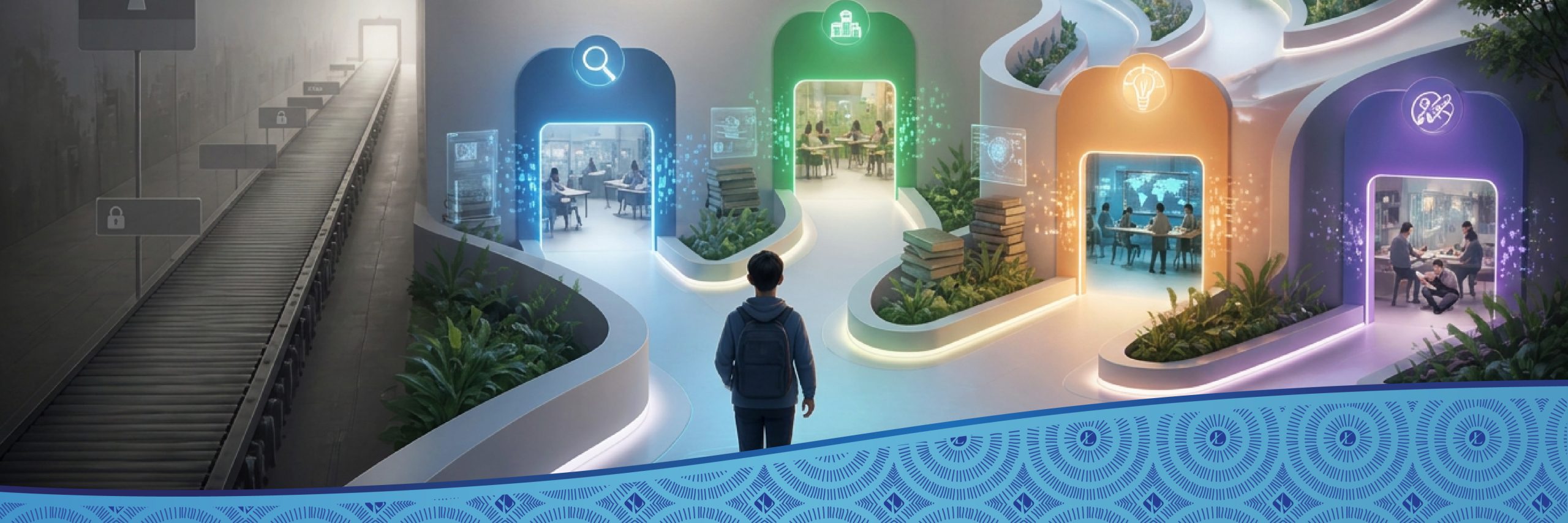
Most learning and training, and by default most learning management systems still operate using the one-size-fits-all conveyor belt system. A course gets built, arranged into a tidy sequence, and then delivered to everyone in exactly the same order. Page one, page two, quiz, next module. Repeat until complete.
The design works perfectly but in practice it unfolds quite differently. You start noticing that while some learners are sprinting through the content, others are hitting walls and potholes that you never anticipated. They made some progress, but somewhere around module three they completely stopped.
This is where the trainers and teachers step in to compensate. They send reminder emails, call or even reteach sessions online. When this doesn’t work, courses are duplicated into “beginner” and “advanced” versions, and they spend many hours maintaining these. Not sure where everyone is, they create new spreadsheets to track progress for the whole group and then spend more hours trying to maintain this.
Can you hear the hours piling up and the frustration mounting? None of this is because the content is at the wrong level. The blame falls squarely on the design of the learning path – a single-lane road with no exits that could so easily have been an adaptive learning pathway with multiple routes to reach the learning goals!
What Adaptive Learning Actually Looks Like
When people hear “adaptive learning,” they sometimes picture a mysterious AI humming away in a server room, making deep and inscrutable decisions about human potential.
The reality is considerably less cinematic and considerably more useful.
In Moodle, adaptive learning is really just setting up the right structures that respond to learners’ activities in real time. You build a course, you add a few decision points, and the system follows the logic you’ve already laid out.
Here’s an example of how this works: when creating quizzes, you can define conditional rules that guide learner progress. If a learner scores below a certain threshold, they are directed to a different pathway where they can revisit the content or work through supporting material before retaking the quiz. Learners who meet the required threshold can move forward or choose to explore more advanced material.
In this way, the quiz functions like a conditional gate: meet the requirements and the gate opens; miss them, and the learner is redirected to additional support before progressing.
The Real Change Happens Behind the Scenes
After a few weeks, most of our clients who implement this start noticing the admin load dropping. Once their LMS starts working harder, they notice with relief that they start doing less of the manual maintenance. There are fewer emails explaining where people should go next, and fewer duplicated courses for different levels. Less time is spent trying to remember who needs extra support and who’s ready to move on, because the system reliably follows the logic that it was designed to implement.
The Path Forward
 Those old paperback adventures worked because they responded to you in a structured way. Turn here. Try this. Go back and try again.
A well-configured Moodle does exactly that. The content stays the same, but the sequence adapts to learners in real time. The course stops feeling like a stack of pages to get through, and instead feels more like a journey with twists and turns, and an ending in sight.
If your LMS still treats every learner the same, the extra work usually ends up back on your team.
Limina helps organisations design Moodle learning environments that guide learners more clearly, reduce unnecessary administrative complexity, and make large-scale learning systems easier to manage over time.
You can also explore our upcoming resources on adaptive learning pathways, learner engagement, and learning-system design, or book a conversation with us to discuss how this could work in practice within your own environment.
By Chantal Tarling