
What Do We Know About Assessment?
In this Article
At Limina, we spend a fair amount of time digging into research and specifically anything learning-related. Our purpose is to make sense of what the research is telling us and work out what it means for practice.
Assessment research is this month’s focus. It has travelled through quite a few territories over the past 50 years. Some ideas arrived, some were refined, and others kept resurfacing in new forms. Taken together, they tell an interesting story of how our understanding of assessment has changed.
So, before we get to the current questions around assessment and AI (next week!), we start the October Assessment blogs by asking: What have we learned about assessment over the past 50 years, and what does this mean for the way we design it today?
A Stroll Down Assessment Memory Lane
Over the past century, research into assessment research has wandered through different territories, so to speak.

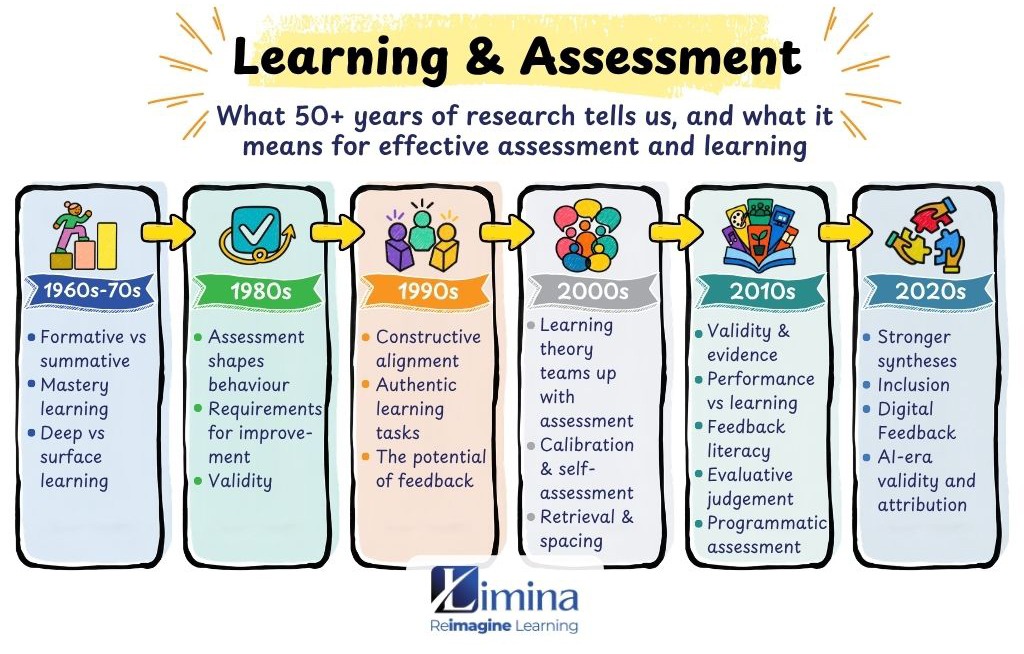
1960s-1970s
In the 1960s and 70s, researchers started distinguishing between assessment used during learning and assessment used to judge achievement at the end. This formative/summative discussion fed into mastery learning, where assessment during learning could identify gaps and guide next steps. Researchers also distinguished between deep and surface approaches to learning, showing that learners change how they learn depending on what they believe a task requires.
1980s
Along with neon and fishnets, the 80s welcomed the idea that assessment can shape learner behaviour as well as record it. Researchers explored how learners adjust their study patterns according to what is assessed, and how improvement depends on understanding what is required, comparing current performance with that standard, and acting on the gap. The 80s also brought greater attention to validity, including how assessment scores are interpreted and used.
1990s
As Take That and the Spice Girls took the stage in the 90s, so did authentic learning tasks, constructive alignment and formative assessment. Biggs introduced constructive alignment, linking learning outcomes, learning activities and assessment. Researchers also argued for assessment tasks with meaningful, real-world relevance, rather than work destined for the bin once the marks were awarded. Feedback research became more prominent too, with growing caution that feedback works best when it keeps attention on the task and learning process.
2000s
The new millennium rolled in, along with a much stronger integration of learning theory and assessment research. Calibration research explored how accurately learners can judge their own performance, including that familiar gap between “I’m going to get full marks!” and the rather less glorious result that eventually appears.
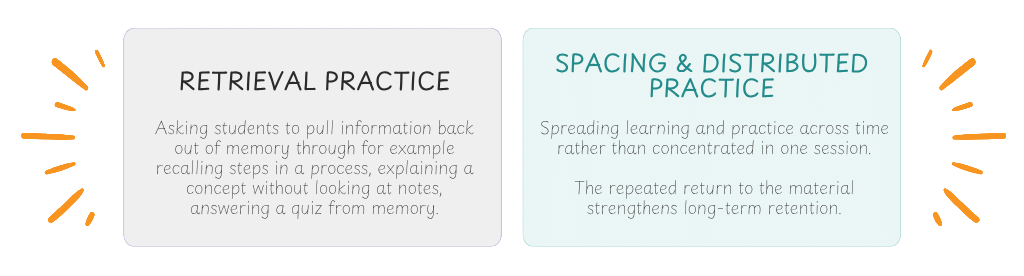
Researchers also refined what we know about feedback, with feedback on the task and learning process emerging as particularly useful. At the same time, retrieval and spacing came into sharper focus: retrieving information strengthens later retention, while returning to learning across time helps it stick.
2010s
While we were singing Uptown Funk and Shape of You in the 2010s, assessment researchers in the hallowed halls of universities were increasingly focused on judgement and the quality of evidence. Validity became central to the question of how well assessment evidence supports the claims we make about learning.
Researchers also drew greater attention to the difference between performance in the moment and learning that lasts. Doing well on a task tells us something about performance at that point in time. Stronger claims about lasting or complex learning need evidence gathered across tasks, contexts and time. Programmatic assessment developed around this idea, bringing multiple pieces of evidence together to build a stronger picture of learning.
The 2010s also saw the rise of feedback literacy and evaluative judgement, with greater emphasis on helping learners recognise quality and judge their own work more accurately.
2020s
As the Eras Tour redefined box-office expectations, the public release of large language models such as ChatGPT, Claude, Gemini and DeepSeek changed the conditions around assessment once again. Education researchers are, of course, still waiting on feedback from Reviewer 2, but the research published so far keeps circling back to themes that have been developing for decades.
Large classroom syntheses and meta-analyses continue to strengthen the evidence for retrieval practice, self- and peer-assessment, while other researchers are exploring feedback in digital environments and assessment design that better includes learners with disabilities.
Generative AI has also brought assessment validity sharply into focus. In the past, little Johnny’s essay written by Mom, his sister or a helpful friend was already a problem. Now anyone with digital access has a relatively capable writer in their pocket, ready to help with that one important project, the next assignment and every one after that.
Teachers have wrestled with this problem for decades: a beautifully written submission does not necessarily tell us how much learning has taken place, or how much of the work can be done independently. AI has simply made that old assessment question much harder to ignore.
As we wound our way through the history of assessment research, the terminology changed, but several important ideas kept resurfacing. Those recurring questions give us a useful set of principles for practice today.
Principles to Guide Assessment Practice
Assessment Shapes Learning Behaviour

Learners quickly work out what counts. Assessment influences what they study, where they put their effort and the strategies they use to prepare.
The principle: Design assessment to encourage the kind of learning you actually want to see.
Validity
Assessment gives us evidence from which we make claims about learning. A quiz can tell us something about recall. Applying ideas, solving problems or exercising judgement requires different kinds of evidence.
The principle: Make sure the assessment produces evidence that fits the learning you want to understand. The assessment needs to give learners a fair opportunity to show what they can actually do, and does not introduce unnecessary barriers to the learning being assessed.
Formative Assessment Works Through Action
Assessment becomes formative when the evidence changes what happens next. It can show the teacher what needs more attention and help learners see what they need to practise, revisit or improve.
The principle: Use assessment evidence to guide the next learning action.
Feedback Needs to Lead to Action

complete next. It should guide learners to revise, retry, compare, explain or apply their learning.
The principle: Keep feedback focused on the task or learning process, and give learners an opportunity to use it.
Retrieval and Spacing Strengthen Learning

Assessment can strengthen learning when learners repeatedly retrieve knowledge from memory and return to important ideas over time.
The principle: Build repeated opportunities to retrieve and use important learning across the course.
Assessment Can Develop Learners’ Judgement

Assessment can help learners learn what good work looks like. Comparing their work against clear criteria, examples and the work from their peers gives them practice and teaches learners to spot strengths and weaknesses, and importantly, identify areas for improvement.
The principle: Use assessment to develop learners’ ability to judge quality.
The Bigger the Claim About Learning, the Stronger the Evidence
A single task may provide enough evidence of recall or a familiar procedure. Claims about complex learning that involves judgement, leadership, problem-solving and professional capability need evidence across different tasks, situations and points in time.
The principle: Build in different forms of assessment to collect a pattern of evidence when the learning you want to understand is complex.

In Closing
After 50 years of research, one question remains unwavering when it comes to assessment:
What can we reasonably say about the learning from the evidence this assessment gives us?
Assessment shapes what learners pay attention to, practise, retrieve, revise and learn to judge. At the same time, it gives us the evidence we use to understand what learning has taken place. That makes assessment design an integral part of learning design.
When designing assessment, it’s great to start with two guiding questions:
- What kind of learning are we trying to support?
- What evidence will show us how well that learning has happened?
Generative AI has made both questions considerably harder to ignore. Next week, we’ll look at what AI is changing with regard to assessment, and the clues in the past 50 years of assessment research that help us respond to this.
Sign up for our newsletter
If you’ve enjoyed this blog, consider signing up for our newsletter to ensure your copy lands in your inbox each Thursday afternoon.

Dr Isabel Tarling – CEO
Isabel Tarling is a learning sciences scholar, programme designer and education researcher, with a PhD from the University of Cape Town. Her research in online and technology-supported learning forms the foundation for much of her writing. She aims to build easy-to-understand bridges between evidence-based research and its everyday application in real-world contexts. Isabel is the founder of Limina, where these ideas are put to work to reimagine learning for organisations of all shapes and sizes.
Research has a habit of getting stuck between the pages of journals and books, or somewhere between academic language and everyday practice. Our blogs help get those ideas moving. We dig into the research, unpack complicated ideas and work out what they mean for people who design, support and care about learning. Then we draw out useful principles, processes and strategies that can travel into practice, across all the wonderfully varied places and ways in which learning happens.