
What Makes Evidence Credible?

In this Article

Last week, we met Sito, an apprentice who proudly presented his completed Portfolio of Evidence to his assessor. Every activity was recorded, boxes ticked and pages signed off. Sito thought he’d done a splendid job!

His assessor was less convinced. A few questions revealed that despite the perfect portfolio, Sito had learnt surprisingly little during his time at the workplace.

The portfolio could not answer key questions like:

  • Which tasks could Sito perform independently? 
  • What decisions had he made along the way? 
  • How had he improved with practice and feedback? 

Questions like these are critical wherever Work Integrated Learning (WIL) is assessed, from artisan training to university programmes.

What Makes Evidence Credible?
Portfolios of Evidence are widely used in WIL. However, as Sito’s story illustrates, their educational value depends on how they’re designed, what evidence students collect and how that evidence is assessed.

Sito’s perfect portfolio has an uncomfortable echo in South African research. Scholtz (2020) examined workplace learning assessments across six diploma programmes in one university’s business faculty. Portfolios contained company brochures, organisational charts and tick-box lists, with little evidence linked to learning outcomes. What’s more, reflection was often missing or superficial. Supervisors’ appraisals rated qualities such as communication and work performance, yet omitted the programme’s learning areas, and scores did not always include explanatory information.

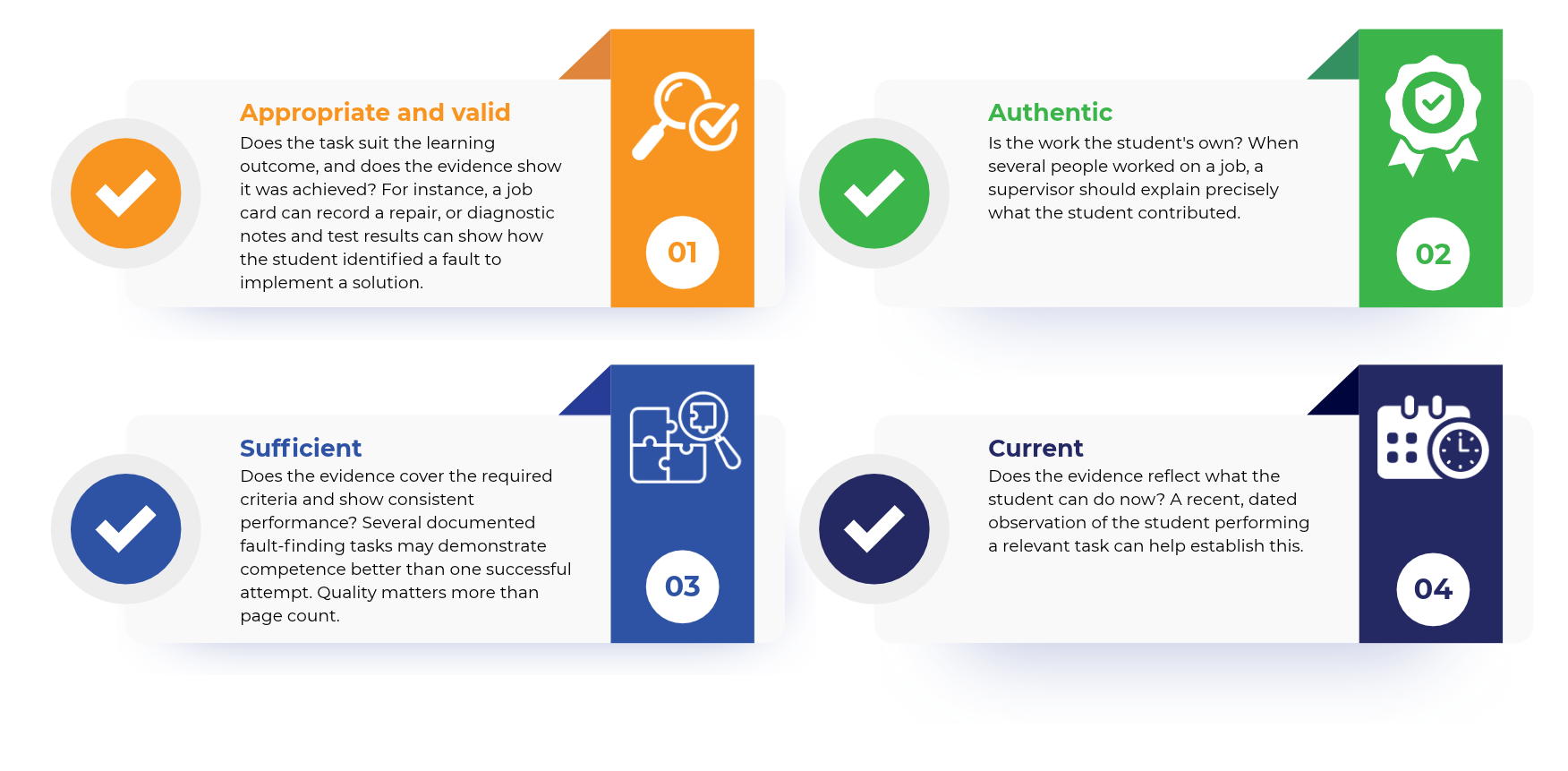
What should a credible portfolio then contain? SAQA’s (2014) assessment policy requires assessment to match learning outcomes, with criteria established before learning begins. SAQA-registered assessor unit standards describe four established tests for evidence:

Authentic evidence establishes whose work it is, while authentic assessment reflects how closely assessment aligns with real workplace practice. 

In their systematic review of 20 WIL assessment studies, Lasen and colleagues (2018) identified some weaknesses in assessment practices. In some cases, workplace partners like supervisors or mentors awarded high marks (or the opposite) with little constructive feedback. To improve the effectiveness of WIL assessments, there needs to be greater involvement of workplace partners in their design and execution to ensure better alignment between reflective tasks and students’ WIL experiences. 

For Sito, a record of what he actually did, why he made particular decisions, and feedback linked to the learning outcomes would give his assessor much stronger grounds for judgement.

Six Questions When Designing WIL Portfolio Assessments

Drawing on this research and the evidence criteria above, here are six questions to ask when designing or reviewing a Portfolio of Evidence:

What should students demonstrate?

Are the learning outcomes and assessment criteria clear, including the knowledge, skills, judgement and behaviours students need to develop?

What opportunities will they need?

Will workplace activities give students meaningful opportunities to demonstrate these outcomes?

What evidence should they collect?

Which work samples, observations or explanations will demonstrate what they've learnt and can do?

How will we verify their work?

Can supervisors confirm specifically what students did and how it relates to the learning outcomes, particularly when working in teams?

How will feedback support learning?

Will students receive feedback, reflect on their decisions and have opportunities to demonstrate improvement?

Is the evidence sufficient and current?

Is there enough recent evidence to assess students against the required standards?

Let’s Put This Into Practice

Ethan is a TVET student completing his training and workplace learning in the motor industry under Mr Lwazi Mtembo.

Like Sito, Ethan needs to build a Portfolio of Evidence to demonstrate what he learns during his WIL placement.

At Limina, our Tech team developed the Portfolio Builder, a bespoke Moodle plugin that helps students collect and organise evidence of their workplace learning. Mr Mtembo used the Portfolio Builder to create reflection prompts and questions, tasks and assessments that the students need to complete on a weekly basis during their six-week WIL placements.

In this short video, Mr Mtembo and Ethan explain how they use Portfolio Builder to collect evidence of workplace learning, build the portfolio as his internship progresses and assess this learning. 

Ethan’s example helps us see how these six questions can guide the evidence students collect, how their work is verified and what feedback supports their development. 

At the workshop, Ethan then had to upload a photograph of a completed repair with a voice note explaining what he did, the decisions he made and what he learnt. Ethan’s workplace supervisor can add observations and feedback, helping Mr Mtembo understand what Ethan can do independently and where he needs further practice.

Portfolio Builder provides a way to collect and organise this evidence in Moodle, while the learning activities, assessment criteria and feedback processes add tremendous educational value.

The next time you look through a student’s portfolio, pay attention to what you can actually learn about them from the evidence they’ve collected.

Would Sito’s portfolio pass that test?

Would yours?

Download Limina’s Guide for Designing Portfolios to Provide Credible Evidence.

Sign up for our newsletter

Would you like the 7 Principles for Assessment Design beside you while you plan? Sign up for the Limina newsletter, and we’ll send you our weekly blog, plus a print-ready copy to save, print or share with your team.

Your subscription could not be saved. Please try again.
Your subscription has been successful.

Newsletter

Subscribe to our newsletter and stay updated.

Dr. Isabel Tarling – CEO at LiminaDr Isabel Tarling – CEO

Isabel Tarling is a learning sciences scholar, programme designer and education researcher, with a PhD from the University of Cape Town. Her research in online and technology-supported learning forms the foundation for much of her writing. She aims to build easy-to-understand bridges between evidence-based research and its everyday application in real-world contexts. Isabel is the founder of Limina, where these ideas are put to work to reimagine learning for organisations of all shapes and sizes.

Research has a habit of getting stuck between the pages of journals and books, or somewhere between academic language and everyday practice. Our blogs help get those ideas moving. We dig into the research, unpack complicated ideas and work out what they mean for people who design, support and care about learning. Then we draw out useful principles, processes and strategies that can travel into practice, across all the wonderfully varied places and ways in which learning happens.