


Changing How We Engage with Learning
In this Article
Think back to an online course you clicked into. Perhaps a compliance module, a walkthrough of a new system, or an induction for a new role you started. Did it feel alive, or like a filing cabinet of content that someone had bolted onto the internet?
The difference between a ‘living’ course and a filing cabinet usually comes down to a single word: interaction. A course can hold excellent material and still feel completely dead. This is because reading pages of content, clicking through slide after slide is not the same as engaging with the learning. It’s this difference: between passively viewing vs actively learning, that we refer to as interaction.
Different Types of Interaction
Terry Anderson, a researcher who spent years studying how people learn online described three kinds of interaction that moves learning from passive to active, and once you see them, you start noticing their presence – or absence – everywhere in online or F2F learning!
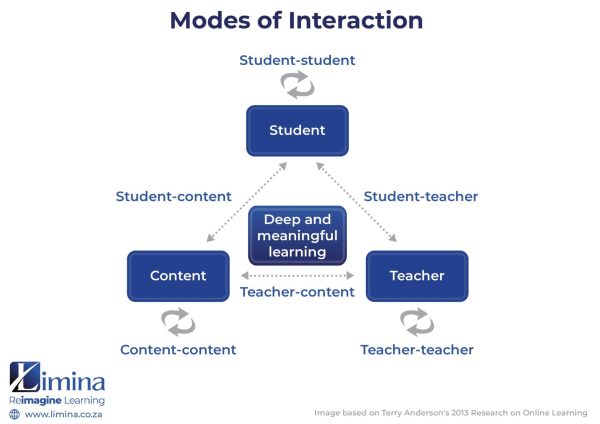
The first is interaction between the learner and the content: the person actually engaging with the material, watching, reading, trying something, wrestling with a problem, rather than scrolling past it. The second is interaction between the learner and an instructor or expert providing guidance, feedback or a knowledgeable presence that responds to where the learner needs support. The third is interaction between the learner and other learners: people discussing, comparing, questioning, and learning from one another.
If you’d like to read the original source material, visit: https://www.aupress.ca/app/uploads/120146_99Z_Anderson_2008-Theory_and_Practice_of_Online_Learning.pdf

Do I Need ALL THREE in a Course?
Anderson reassures overstretched learning design teams and online teachers that as long as one of those three interactions is strong, deep and meaningful learning can still take place. So at the start, if you focus on deliberately adding one kind of interaction to a course, the other two can be lighter, or can even be absent, without the whole experience falling apart.
A course rich in learner-to-content interaction can work with little instructor contact. A course built around lively peer discussion can work even when the content is lean.
Designing Interaction in Learning
Designing for interaction matters enormously for a lean startups or growing organisation. We work with many SME or NGO clients, who are moving training from in-person to their new Moodle LMS. In most cases, their first step is to add a few PDFs and a quiz at the end of each module / unit. But the design should not stop here as this merely creates the filing-cabinet style of learning, where learning feels lonely and let’s be honest, quite boring.
The fix for the filing-cabinet-type learning is to add at least one strong channel of interaction into the course (but hopefully more!) Adding interactivity, especially between facilitators <-> learners, or learners <-> learners, requires time, resources and often extra salaries for facilitators or learning coaches. This is why most smaller organisations start by adding learner <-> content interaction.
LEARNER <-> CONTENT INTERACTION
Learner <-> content interaction can be added in many different ways. Adding short interactive activities like drag-and-drops, short quizzes, content reveals like accordions, or similar activities. These types of activities are included in Moodle’s native activities options, and can be tracked and graded (if required).
More advanced types of activities may include games or gamification elements, embedded activities from online games or learning platforms, or adding questions strategically into videos that learners first have to answer correctly before they can watch the remaining parts of a video.
These types of learner <-> content activities mean students are not passively scrolling through content, but have to do something as they engage with the content. More importantly, the learner doesn’t only engage with the content, but this engagement can, in many cases, be recorded and added to the Moodle gradebook. This means their engagement with the learning activities can give facilitators and teachers insight into the kinds of learning engagement taking place, rather than hoping and praying that learning is actually happening!
LEARNER <-> LEARNER INTERACTION
Adding learner <-> learner interaction isn’t as difficult as you may think.
Let’s think of a face-to-face (F2F) course: how would you create learner <-> learner interaction in a workshop or training room? You’d likely create small-group discussions, peer-to-peer work or even larger group-work assignments. It’s easy because everyone is in the same room at the same time. It also means, depending on the size of the group, complex logistics, high costs for transport, and possibly accommodation, and time-off-work for many people in the organisation that is not spent on their day-to-day responsibilities.
In online learning, you can use different tools to create these kinds of learner <-> learner interaction. Moodle LMS activity tools like the forum support synchronous and asynchronous interaction. If set up correctly, your student can work together to join discussion groups, help each other, share how they approached a task, or leave a question that someone else can answer. It takes a little thinking and time to set up, but then grows richer the more people take part.
In Conclusion
Designing learning that engages and excites students, and moves them beyond passive scrolling and clicking, takes time. Compared to new furniture, it’s less of the ‘blow-up couch’ scenario, and more of the ‘IKEA’ assembly-required setup. The results however speak for themselves – engaged, active learners who are more likely to finish courses! An investment worth the time and effort required!
Ready to bring your Moodle courses to life?
Great online learning isn’t about adding more content—it’s about designing meaningful interactions that keep learners engaged. If you’re wondering how to make your Moodle courses more interactive, learner-centred, and effective, we’d love to help.
Book a complimentary 30-minute conversation with the Limina team to explore practical ways to create learning experiences that learners don’t just complete—they remember.
Get Your Complimentary Copy of Anderson’s Interaction Model
Subscribe to the Limina newsletter and receive a free copy of Terry Anderson’s Three Types of Interaction Model —a practical framework for designing more engaging and effective Moodle learning experiences.
Join our newsletter and download your complimentary guide today.
(Once you submit, it takes 10-15 min for the model to arrive in your inbox!)

Dr Isabel Tarling – CEO
Isabel Tarling is a learning sciences scholar, programme designer and education researcher, with a PhD from the University of Cape Town. Her research in online and technology-supported learning forms the foundation for much of her writing. She aims to build easy-to-understand bridges between evidence-based research and its everyday application in real-world contexts. Isabel is the founder of Limina, where these ideas are put to work to reimagine learning for organisations of all shapes and sizes.